

Moving from France to the Northern Beaches was not just a change of scenery — it was a complete reimagining of how I think about interiors. The light is different. The materials are different. The way people live is different. Here is what that shift taught me.
People always ask me the same question at dinner parties: "Why Sydney?" And the honest answer is not particularly romantic. We did not move here chasing a dream. We moved for my husband's work. I was pregnant with our first child, leaving behind everything I knew — my family, my friends, my career, my language — for a city I had never even visited. I cried on the plane.
That was three years ago. And I would not go back for anything.
What I left behind
In France, I studied engineering first, then interior design at a school in Paris. I worked for several years in design — first in residential projects, then in commercial spaces. I understood French interiors deeply: the proportions, the materials, the unwritten rules about what goes where and why. I could walk into a Haussmann apartment and know immediately what it needed.
I also worked with IKEA for Business, designing commercial and retail spaces. That experience taught me something invaluable: how to design within real constraints. Not unlimited budgets and showroom conditions, but actual budgets, actual timelines, actual humans who need the space to work on Monday morning. It stripped away any pretension I might have had about design. A beautiful space that does not function is not a beautiful space. It is a failure.
When we left for Sydney, I assumed I would take a break. Have the baby, settle in, figure things out later. I did not expect to start a business within a year of landing.
"I did not move here chasing a dream. I moved for family. The dream came after."
The shock of arrival
The Northern Beaches hit me like a wall of light. I am not exaggerating. After years in Paris — where the sky is grey for eight months of the year and apartments are designed to capture every available photon — suddenly I was living in a place where the sun was almost too much. Where people left their doors open in winter. Where the ocean was ten minutes away and nobody seemed to think that was remarkable.
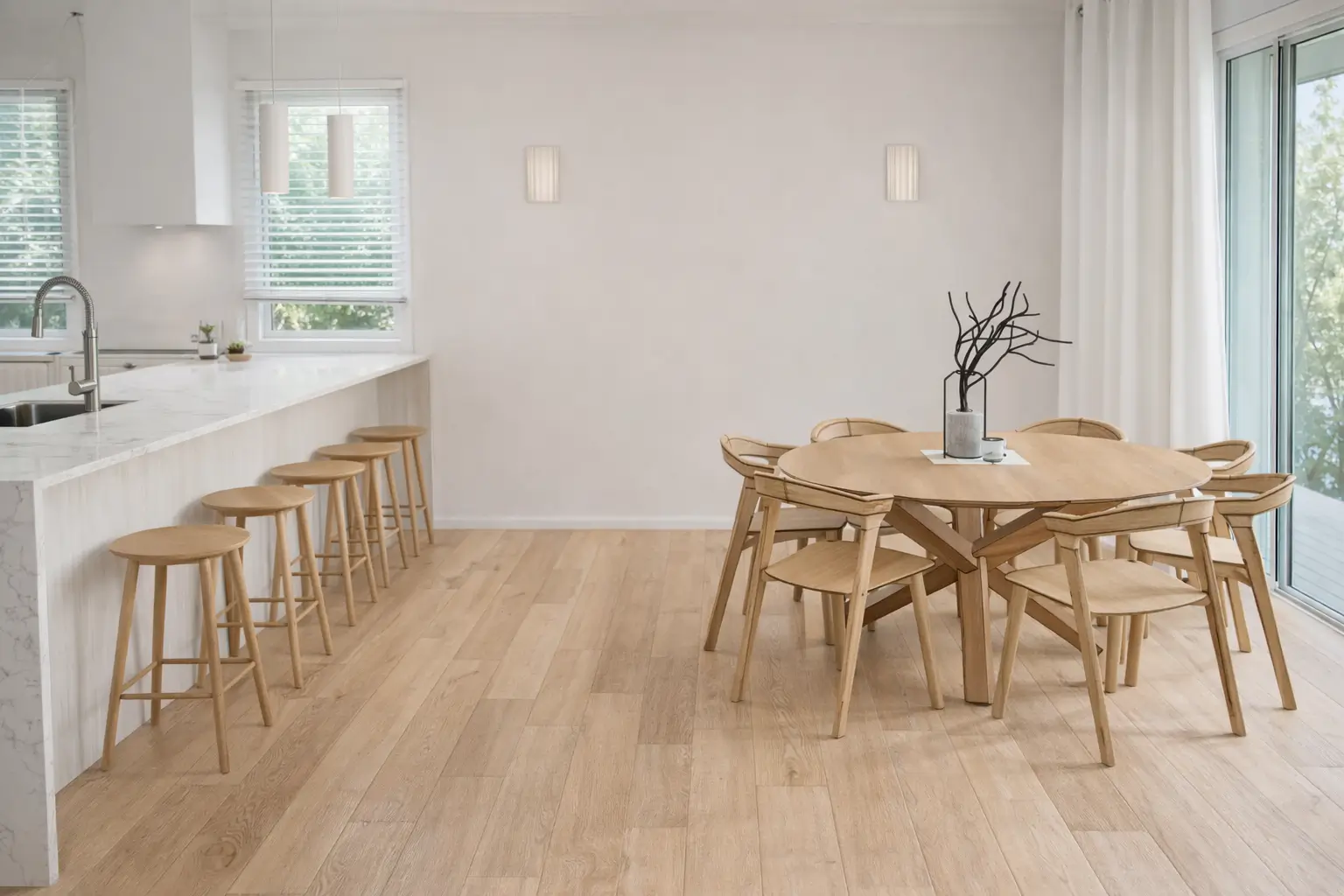
The homes were different too. Open plan. Lots of glass. Timber floors. Big, generous kitchens that opened onto decks. In France, the kitchen is often the smallest room in the house — a practical space, not a social one. Here, the kitchen is the centre of everything. Families cook together, eat together, do homework at the island bench. It took me a while to understand that, but once I did, it changed how I think about designing kitchens entirely.
The other thing that struck me was how much Australians live outside. Not just in summer — all year round. The boundary between inside and outside is much softer here than in France. That has enormous implications for how you choose materials, how you think about flow, how you handle the transition from a polished interior to a sandy backyard. In France, the front door is a hard line. Here, it barely exists.

The quality of light on the Northern Beaches changed everything about how I approach colour, materials, and spatial design.
What I brought with me
Not furniture. We shipped almost nothing from France — just books, some art, and a few pieces with sentimental value. What I brought was a way of seeing.
The French approach to interiors is fundamentally about restraint. About choosing fewer, better things. About letting a room breathe rather than filling every corner. About trusting natural materials to do the work that decoration often tries to do. About accepting — even embracing — imperfection. A cracked tile is not a defect in a French home. It is a sign that someone has lived there.
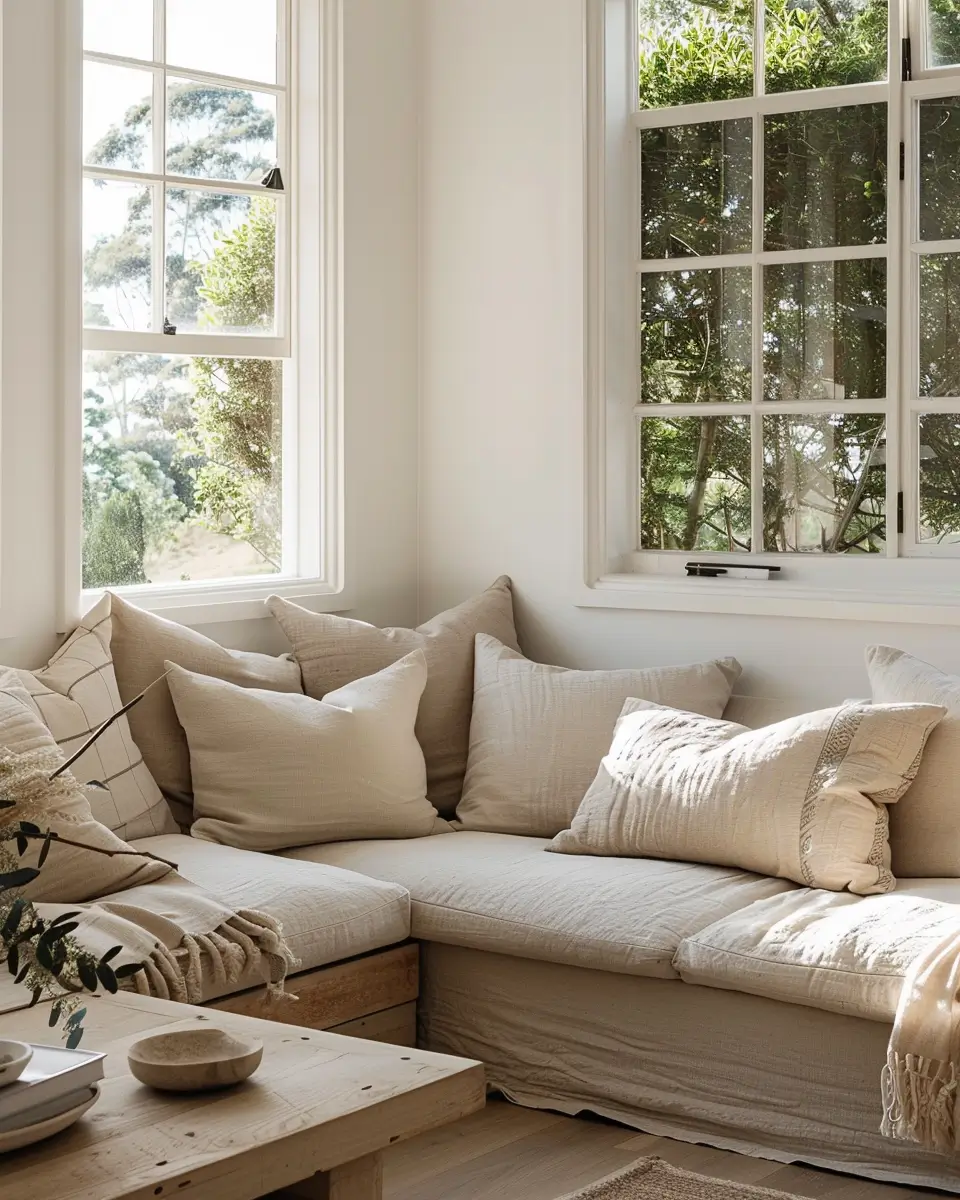
I also brought a deep attention to materiality. In France, we are taught to touch everything. To feel the weight of a fabric, the grain of a stone, the warmth of a timber. This matters here too — maybe even more, because the intense Australian light reveals every texture with extraordinary clarity. A linen curtain that might look flat in a Parisian apartment becomes almost luminous in Northern Beaches light. You can see every thread.
"What I brought from France was not a style. It was a way of seeing — restraint, materiality, and a deep comfort with imperfection."
What Australia taught me
France gave me the foundations. Australia gave me freedom.
In France, interior design can be quite formal. There are strong conventions about how rooms should look, how furniture should be arranged, what combinations are acceptable. It is a culture with deep aesthetic traditions, and while that produces extraordinary results, it can also be constraining. There is a right way to do things, and deviating from it takes courage.
Australia is looser. More relaxed. Less attached to rules. People here are more open to experimentation, more willing to trust their instincts, less worried about getting it "wrong." That energy is infectious. It has made me braver as a designer. I mix things now that I would never have mixed in France — a raw concrete bench with a vintage French chair, a Japanese ceramic next to Australian eucalyptus, a Scandinavian lamp on a sandstone shelf. These combinations work because Australia gives you permission to try.
Starting the studio
Claire VH Interiors started at our kitchen table. Literally. Our daughter was six months old, I barely knew anyone in Sydney, and my English was functional but far from fluent. Not exactly the ideal conditions for launching a business.
But I kept noticing things. Friends of friends would invite us over, and I would see beautiful homes with one or two things that were not quite right — a layout that blocked the natural light, a colour that fought the architecture, furniture that was too big or too small for the space. And I would think: I could fix that. Not in a dramatic, tear-it-all-down way. Just a few considered changes that would make everything click.
So I started offering to help. First for free, then for a small fee, then properly. The first paid project was a nursery in Dee Why for a couple expecting their first baby. They had bought everything separately — the cot, the dresser, the chair, the rug — and none of it went together. I returned half of it, chose new pieces, reorganised the room, and the whole thing came together in a weekend. They cried when they saw it. I almost cried too.
That was the moment I knew this was what I wanted to do here.
The name on the door
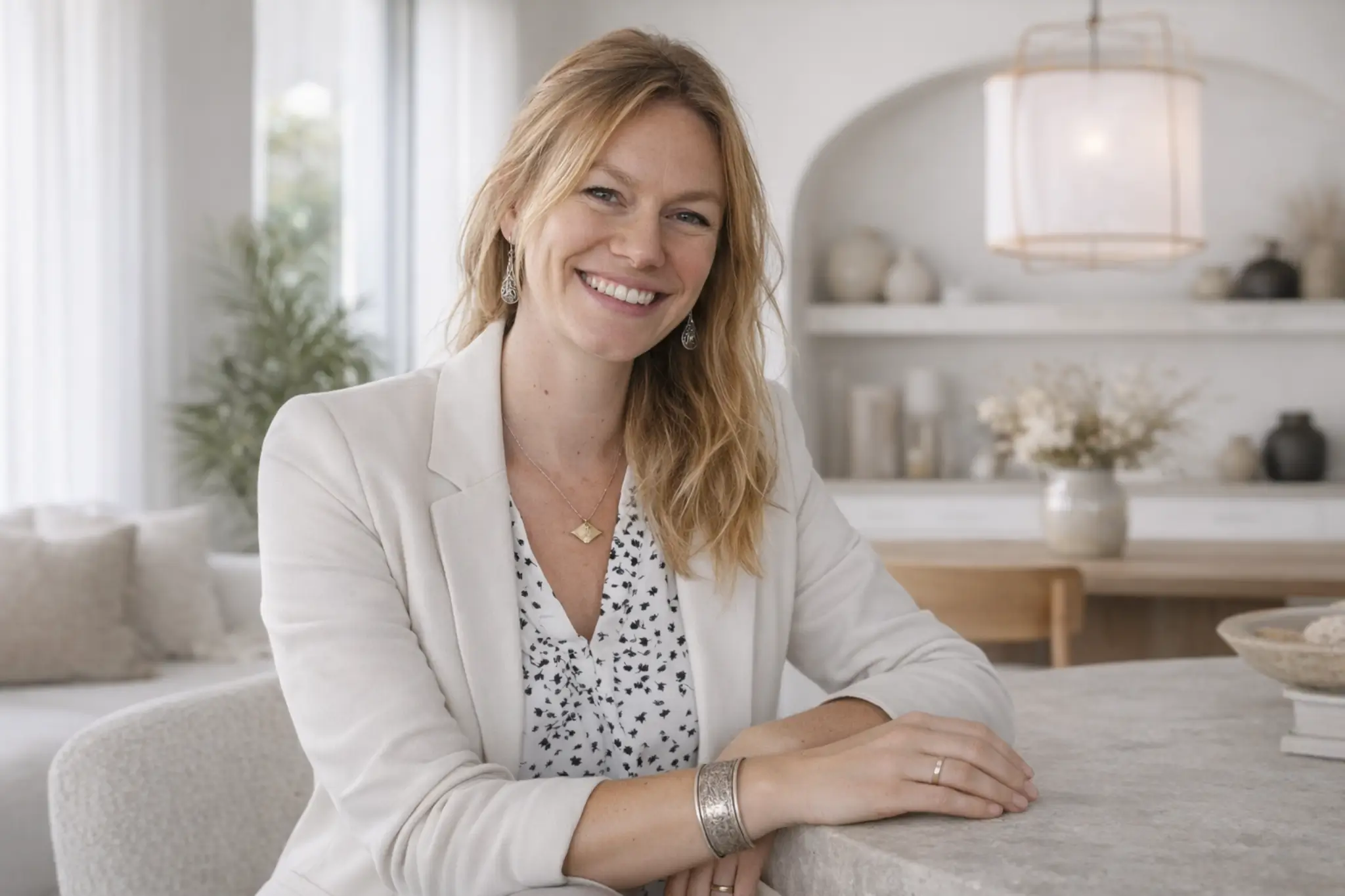
People sometimes ask why I did not choose a more "Australian" name for the studio. The answer is simple: I am not Australian. I am French, living in Australia, making homes for Australian families with a sensibility shaped by both cultures. The name is honest about that. Claire VH Interiors is a French woman designing Australian homes — and that particular combination, that specific in-between, is the whole point.
Every project I work on carries both influences. The French restraint and the Australian openness. The attention to craft and the willingness to experiment. The love of natural materials and the respect for how light and landscape shape a home. I do not try to make Australian homes look French, or French homes look Australian. I try to make homes that feel like the people who live in them — wherever those people come from.
If you had told me on that tearful plane ride that three years later I would be running my own design studio on one of the most beautiful coastlines in the world, I would not have believed you. But here we are. And I am just getting started.
Behind the studio
Personal
French style
Northern Beaches


.png)