
There is a word the French use that has no direct English translation: dépaysement — the disorienting, wonderful feeling of being somewhere completely different. The best interiors do something similar. They transport you.
I grew up in France, surrounded by homes that looked nothing like what you see in design magazines. No one I knew had an accent wall or a feature pendant. The kitchens were small, the furniture was often inherited, and nothing matched in any deliberate way. And yet those homes had a quality that I have spent years trying to understand and recreate: they felt effortlessly, unmistakably right.
Now, living and working on the Northern Beaches of Sydney, I see Australian homes through a slightly different lens. And I have come to believe that the French approach to design — not the clichéd version, not the Haussmann fantasy, but the real, everyday philosophy behind it — translates remarkably well to Australian life.
Here is what I mean.
Imperfection is the point
In France, there is a deep cultural comfort with imperfection. A cracked tile is not a defect — it is character. A wooden floor that creaks underfoot is not a problem to solve — it is a sign that a house has been lived in. This extends to interiors: the French instinct is not to make everything new and uniform, but to let old and new coexist. A mid-century chair next to a modern lamp. A grandmother's mirror above a brand-new console.
Australian homes, especially newer builds, tend to lean the other way. Everything is fresh, clean, symmetrical. That is beautiful in its own right, but it can also feel a bit sterile — like a display home that nobody has actually moved into yet. Introducing a little imperfection, a little history, is one of the fastest ways to make a space feel alive.
"The goal is not a perfect room. The goal is a room that feels like it has been loved for a long time — even if you just moved in last week."
Materials before colours
Walk into a French home and you will notice something: the palette is often remarkably restrained. Whites, creams, greys, naturals. The drama comes not from colour but from materiality — the difference between rough stone and smooth plaster, between raw linen and polished timber, between a matte wall and a glazed ceramic.
This is something I bring to every project, no matter the style. I always start with materials — how they feel, how they catch the light, how they age. Colour comes later, almost as an afterthought. When the materials are right, the room does not need much else.
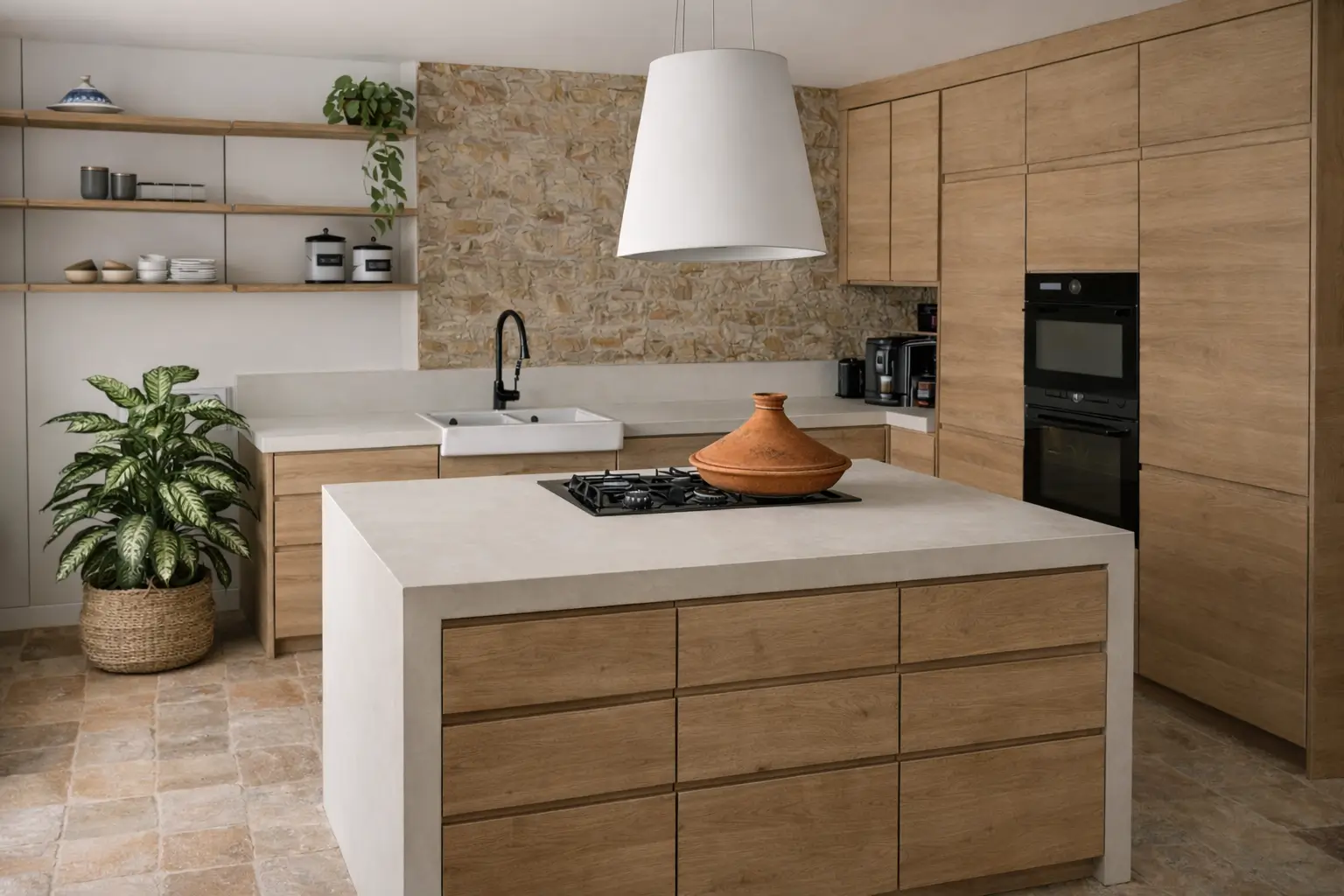
Natural materials — stone, linen, timber — form the backbone of the French approach. Colour is secondary; texture is everything.
Less furniture, more space
French rooms are often quite bare by Australian standards. Not minimalist in the stark, Scandinavian sense — but edited. There might be a sofa, a coffee table, a lamp, and a single piece of art. That is it. The room breathes. You can move through it without bumping into anything.
This is particularly relevant in Australia, where indoor-outdoor living is central to how homes function. When you leave space in a room, you create flow. The eye moves naturally from inside to outside. The breeze reaches further. The room feels bigger, lighter, and more connected to the landscape — which, on the Northern Beaches, is half the reason you live here.
The art of the unfinished
There is a French concept that I think about constantly in my work: the idea that a room should never feel completely finished. There should always be a bare wall waiting for something, an empty shelf, a corner that has not yet found its purpose. This is not laziness — it is intentional. It leaves room for life to happen, for objects to accumulate naturally, for the home to evolve with the people who live in it.
In a culture that loves the "big reveal" — the fully staged, completely finished room photographed on day one — this can feel counterintuitive. But I have seen it work, project after project. The homes that feel best a year later are the ones that were not overfilled on day one.
"A room should never feel completely finished. Leave space for life to happen."

.webp)
Why it works here
Australia and France have more in common than you might think — at least when it comes to how homes feel. Both cultures value spending time at home. Both have strong food cultures that revolve around the kitchen and dining table. Both have climates where natural light plays a central role in how spaces feel throughout the day.
The French approach works in Australian homes because it is fundamentally about comfort, not performance. It is about creating spaces that feel good to be in, not spaces that look good in photographs. And on the Northern Beaches, where the lifestyle is relaxed and the light is extraordinary, that philosophy lands perfectly.
When I work on a project here, I am not trying to recreate a Parisian apartment. I am trying to bring the principles — the comfort with imperfection, the attention to materials, the restraint, the breathing room — and apply them to homes that are unmistakably Australian. The result is something that feels neither French nor Australian, but simply right.
Where to start
If any of this resonates with you, here is where I would begin. Look at your room and ask yourself: what can I remove? Not what can I add — what can I take away? Start with the things that are there because you think they should be, not because you love them. Clear the surfaces. Let the room breathe. Then, slowly, bring back only the things that mean something to you.
That is the French approach in a sentence: keep what you love, let go of the rest, and trust that the space will find its own beauty.
French style
Design philosophy
Materials
Northern Beaches


.png)